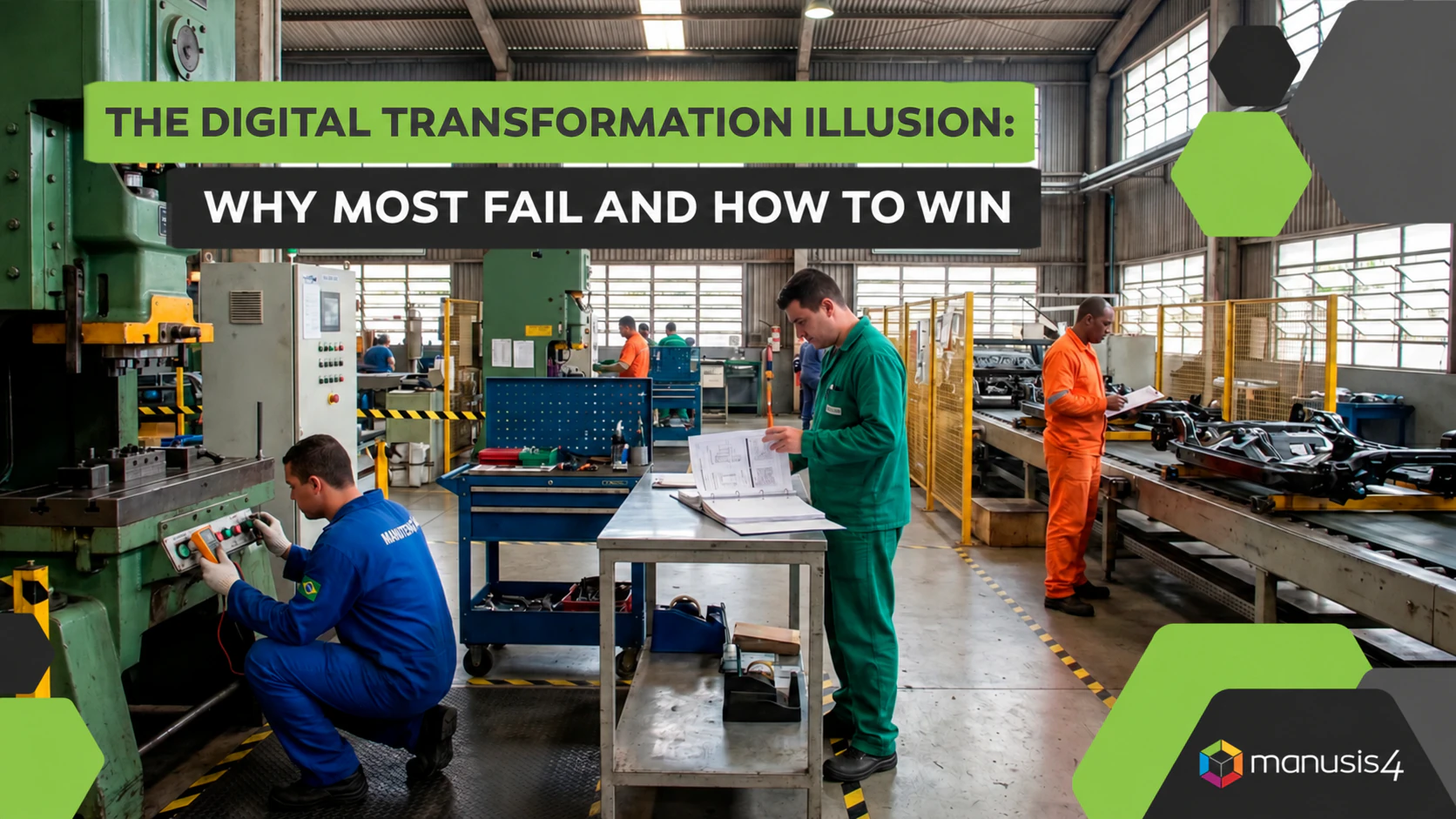
The plant was connected. Sensors installed, dashboard live, contract signed. Six months later, the maintenance manager was still making decisions from spreadsheets. Digital transformation had happened on paper — and stopped there.
This scenario repeats across plants of all sizes. Not from lack of investment, but lack of strategy. The problem is not the technology — it is the narrative surrounding it.
The Problem with the Current Narrative
The market is saturated with solutions promising to "digitize" maintenance with mobile apps and colorful dashboards. It's a dangerously short-sighted view. The real transformation is not about buying the shiniest software or the latest sensor. It's about connecting the shopfloor to the boardroom in a coherent, strategic, and measurable way. Without that connection, the data exists — but decisions are still made in the dark.
The Three Pillars of Digital Transformation
Data Integration: all systems — ERP, CMMS, IoT sensors, quality systems — must speak the same language and feed a single source of truth. Without it, information silos generate more confusion than clarity.
Analytical Intelligence: raw data has no value. What transforms an operation is the ability to extract patterns, predict failures and simulate scenarios. This is where AI and Machine Learning stop being buzzwords and become real competitive tools — with direct impact on MTBF and OEE.
Culture and Process: no technology replaces well-defined processes and capable teams. Platforms that arrive without methodology and without support become pilot projects that die after six months — and this happens in approximately 70% of digital transformation initiatives.
The Hidden Cost of Half-Done Digitization
When a company digitalizes only one point of the chain without integrating data into the CMMS and service order planning, it creates a new bottleneck. The alerts arrive. The operational response, doesn't. This misalignment generates rework, erosion of trust in the tools and, frequently, the silent abandonment of the system — which ends up coexisting with the spreadsheet it was supposed to replace.
Practical Recommendations
- Define the problem before choosing the tool — technology without diagnosis automates chaos.
- Integrate from the start — isolated systems produce data nobody uses.
- Train the team before going live — zero adoption equals zero ROI.
- Measure what matters — OEE, MTBF, cost per work order, response time. Without indicators, there is no management.
- Scale only what worked — a poorly evaluated pilot multiplies the problem, not the solution.
FAQ
Why do most digital transformations in industry fail?
The main cause is not technological — it is cultural and procedural. Initiatives that ignore team training and integration between systems create data silos that generate no decisions. Without redesigned processes, the software becomes another underused tool.
How long does a successful digital transformation take?
Well-structured implementations typically show measurable results in OEE and MTBF between six and twelve months on a pilot line. The full transformation horizon — with consolidated culture and process — is two to four years.
Those who treat digital transformation as an IT project are solving the wrong problem. The shopfloor does not need more dashboards — it needs faster decisions based on real data.