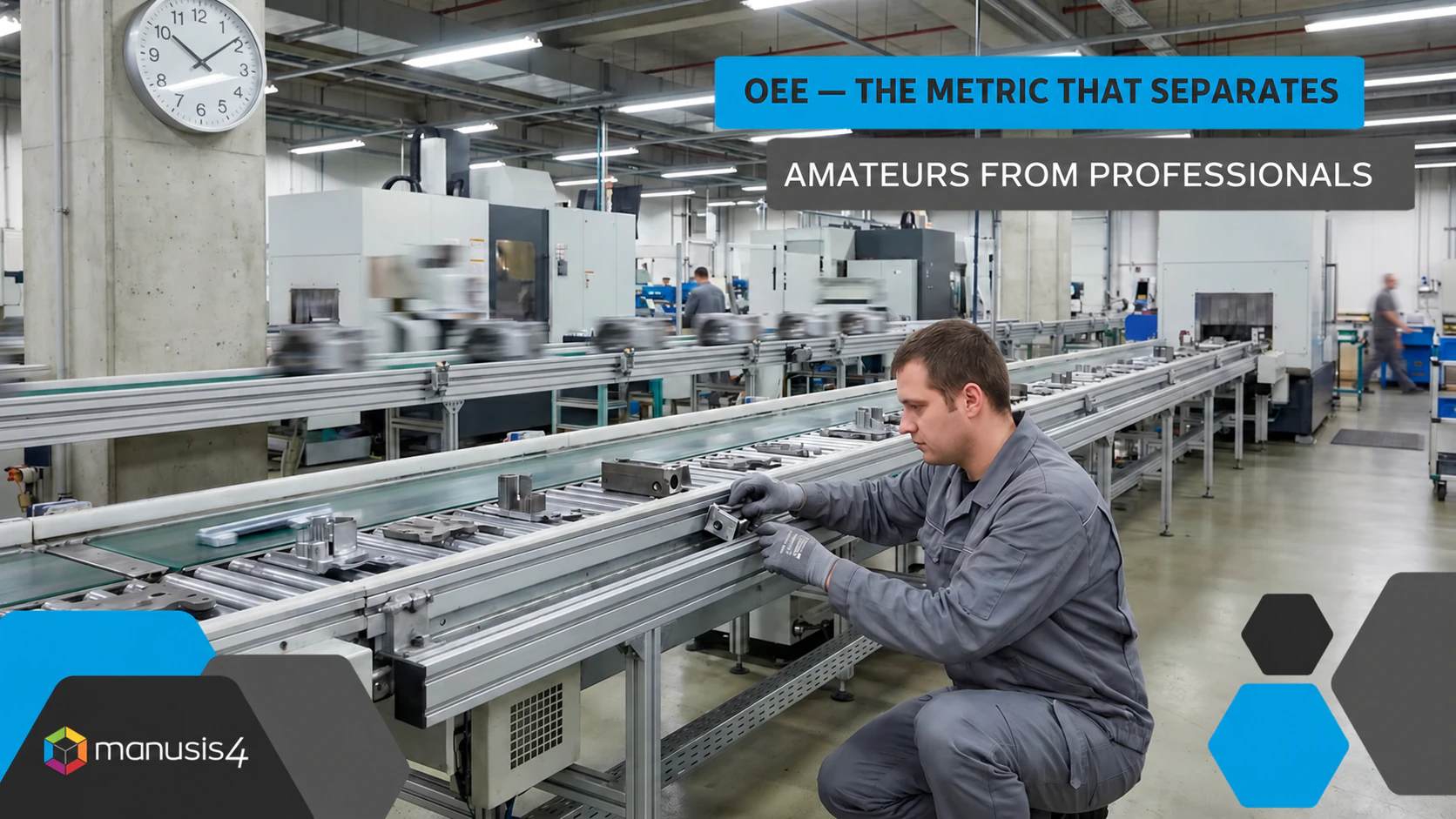
The machine stopped. The panel flashes red, the operator calls maintenance and the conveyor suddenly empties. While the technician tries to diagnose the origin of the mechanical failure, the lost minutes silently erode the profit margin for the entire shift. High-performance operations require definitively abandoning analyses based on intuition, focusing on irrefutable facts extracted directly from machinery.
OEE (Overall Equipment Effectiveness) reveals the unquestionable truth about how industrial assets behave in real time, crossing data on availability, execution rate and quality approval.
Why Managing Efficiency in the Rearview Mirror is an Operational Risk
What is frequently observed in factory routines is coordinators calculating percentages in spreadsheets or relying on data manually entered by operators hours after the end of the shift. This is not cutting-edge industrial control; it is data archaeology. Unplanned stoppages reduce OEE between 3% and 5% in heavy industry.
The Three Components Many Ignore
The OEE calculation requires mastery of three distinct fronts: Availability (was the asset ready at the scheduled time?), Performance (when running, did it process material at the maximum specified rate?), and Quality (how many approved units came out versus the volume of waste?). The chronic management vice is concentrating energy only on keeping the axis turning, ignoring that slow speed drastically consumes installed capacity.
In a large appliance manufacturer's assembly line, Availability registered 92% — apparently, a scenario free of severe problems. But Performance was stagnant at 78% and Quality marked 95%. The final multiplication exposed a painful truth: an OEE of only 68%. The losses caused by slowness were not visually perceived by the supervisor and were pulverizing millions in unrealised potential.
OEE is the definitive metric that crosses gross operating time, the machine's actual pace versus the original design and the rate of rework-free products. It exposes the exact fraction of the factory's useful hours, illuminating invisible losses that manual stopwatches cannot detect.
OEE as a Strategic Decision Tool
Uninterrupted monitoring unlocks high-precision tactical manoeuvres. A reliability supervisor, mid-morning shift, can notice that the primary packing machine is achieving only 82% of its programmed delivery and demand an immediate planned stoppage to remedy the technical deviation. Without automation-driven activation, this resource haemorrhage would continue bleeding the final result until the monthly material balance.
FAQ
What characterises a world-class plant in terms of OEE?
The international excellence benchmark, consolidated by the largest industries through TPM methodology, determines that an index of 85% or above attests to highly profitable operations.
Which factors correct the metric quickly on the factory floor?
The priority action is to identify and eliminate imperceptible micro-stoppages. Pauses of three to five minutes to clear blockages or adjust conveyors don't alarm the operator, but they shred performance. Digitalising this count reverses the loss within the same week.