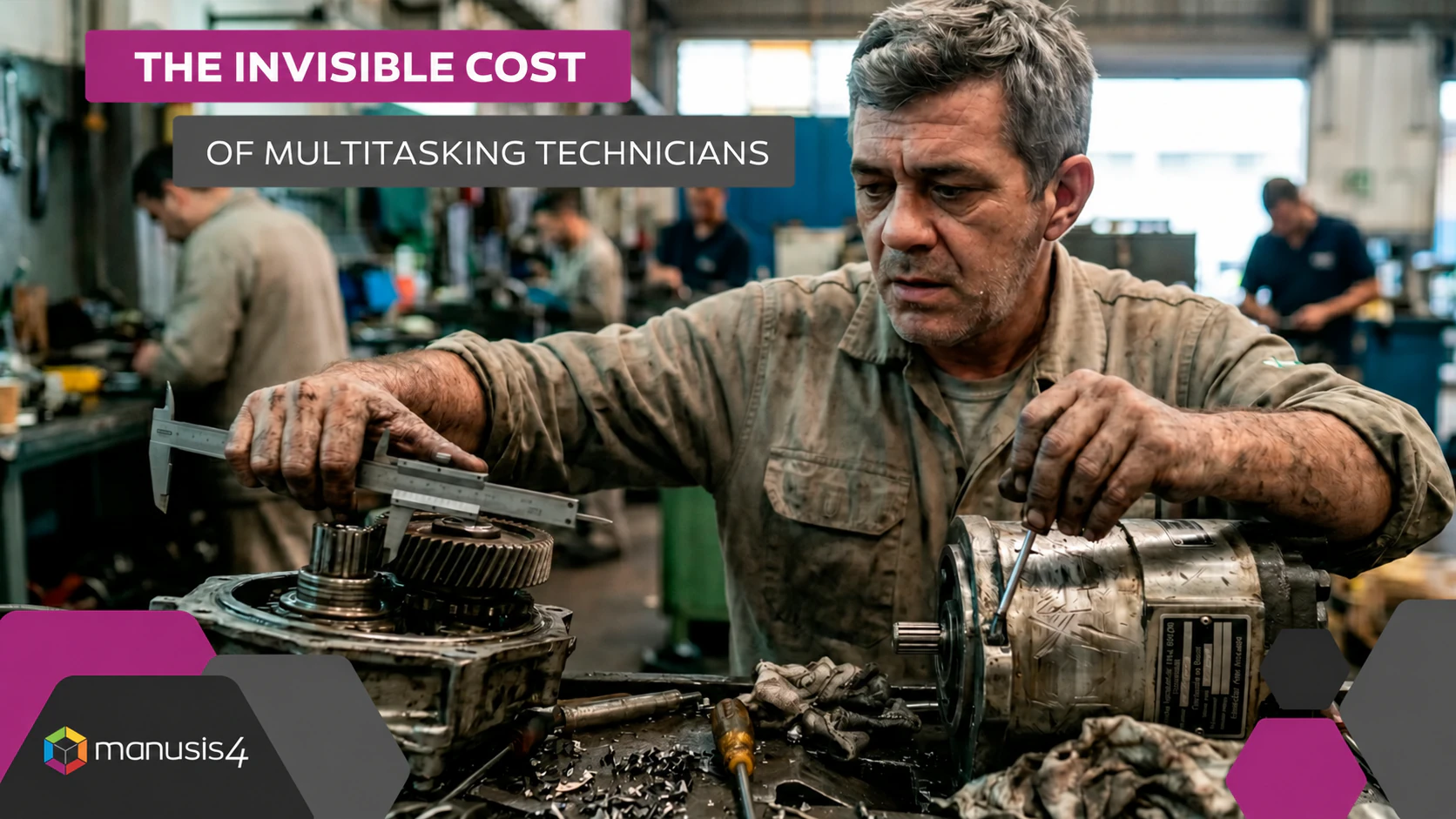
The most dangerous compliment in maintenance
“That guy does everything. Never stops. He's a multitasker.”
Who has not heard that on the factory floor? In almost every company, the multitasking technician is treated as the ideal professional:
- Handles the critical work order
- Answers the manager's WhatsApp message
- Trains the newcomer
- Completes the report
- Fixes HR's air conditioning on the way
- And still updates the system “really quickly”
The result looks impressive. They deliver everything. Appear everywhere. “Save the day” several times a week. What no one sees is the silent cost—and it appears in the indicators that matter most: MTTR, rework, and recurring-failure rate.
The technical truth few people tell
Multitasking does not exist. At least not in the way it is marketed. What exists is rapid switching of attention, and it has a scientific name: switching cost.
Cognitive psychology researchers have demonstrated that the human brain does not perform two complex tasks simultaneously. It switches between them, and every switch involves two stages: changing the goal and activating new mental rules. Individually, each switch costs fractions of a second. Accumulated over a shift, these micro-interruptions can consume up to 40% of productive time.
Every time the brain jumps from one task to another, it:
- Performs worse on the next task
- Forgets details of the previous task
- Makes incomplete decisions without full context
- Accumulates mental fatigue that lasts until the end of the shift
- Creates invisible small errors that only appear as rework days later
At the end of the day, the “multitasking” technician delivers more volume. Less quality. More rework. More emotional strain. The bill always arrives. Just not immediately.
Why does fragmentation affect more than productivity?
The impact of continuous switching goes beyond technical performance. When a maintenance team operates in a state of constant fragmentation, the emotional effect is cumulative—and rarely measured.
Cognitive neuroscience is clear: the human brain was made for deep focus, not continuous fragmentation. Research indicates that after an interruption, the average time needed to regain full concentration is 23 minutes. In a shift with ten interruptions—a common number in understaffed teams—that means nearly four hours of wasted cognitive capacity.
When a team operates this way, it loses:
- A sense of progress throughout the shift
- Clarity about priorities among competing demands
- The sense of a “task completed” that sustains motivation
- The satisfaction of a “job well done” that retains talent
The result is an emotional state that eats away at the team from within. The technician worked all day but feels they accomplished nothing. Solved several problems but finished tired and irritable. Delivered a lot but was left feeling permanently behind.
This invisible strain has a name in reliability literature: it is the human factor that no OEE indicator captures directly, yet which degrades MTBF and inflates MTTR month after month.
The hidden cost no one puts in the spreadsheet
Most managers calculate maintenance costs by adding up parts, labor, and downtime. What does not enter that calculation is the cost of rework caused by cognitive fragmentation.
Industry data indicates that reactive maintenance—often the result of rushed diagnoses and fragmented execution—costs 3 to 5 times more than the same service performed in a planned way. When technicians close work orders under pressure, without focused time for root-cause analysis, the failure returns. And it returns at a higher cost.
In practical terms, the invisible cost of multitasking technicians is not just lower individual productivity. It is the rework cycle that develops when diagnoses are made without focus, jobs are interrupted halfway through, and records are completed from memory at the end of the shift—turning maintenance data into noise rather than intelligence.
There is another cost almost no one accounts for: the loss of tacit knowledge. Senior technicians permanently operating in multitasking mode have no time to transfer knowledge to the team. When they leave—because of burnout, retirement, or turnover—they take years of accumulated diagnostic experience that was never recorded in any system.
Frequently asked questions
Is a multitasking technician a sign of an efficient team?
No. It is a sign of an understaffed or poorly organized team. Real efficiency appears when every professional has enough focused time to perform, record, and analyze—not when a single technician accumulates duties for lack of an alternative.
How can fragmentation be reduced without increasing headcount?
The first step is to make the fragmentation visible. Digitizing the work-order flow identifies which demands interrupt planned work and how often. That data makes it possible to redistribute workloads, automate triage, and protect blocks of focused time for critical tasks.
Which indicator measures the impact of multitasking on maintenance?
The rework rate is the most direct indicator. If work orders are reopened at a rate above 3%, there is evidence that the original execution was compromised—and cognitive fragmentation is one of the most common causes.
The risk missing from the monthly report
The invisible cost of multitasking technicians is not a people-management issue. It is an operational risk. Every work order closed without focus is a future failure in incubation. Every fragmented shift is lost data that will never feed predictive analysis.
Plants already operating with digital maintenance management eliminate much of this fragmentation at the source: automated triage directs the right demand to the right technician without manual interruption. Manusis4 addresses precisely this bottleneck—the work-order flow stops depending on memory and WhatsApp and starts operating with complete traceability, from the initial request to closure.
If your maintenance team still operates in “everyone does everything” mode, the next step is not hiring more people. It is making the fragmentation visible and protecting the focus of those who keep the plant running.