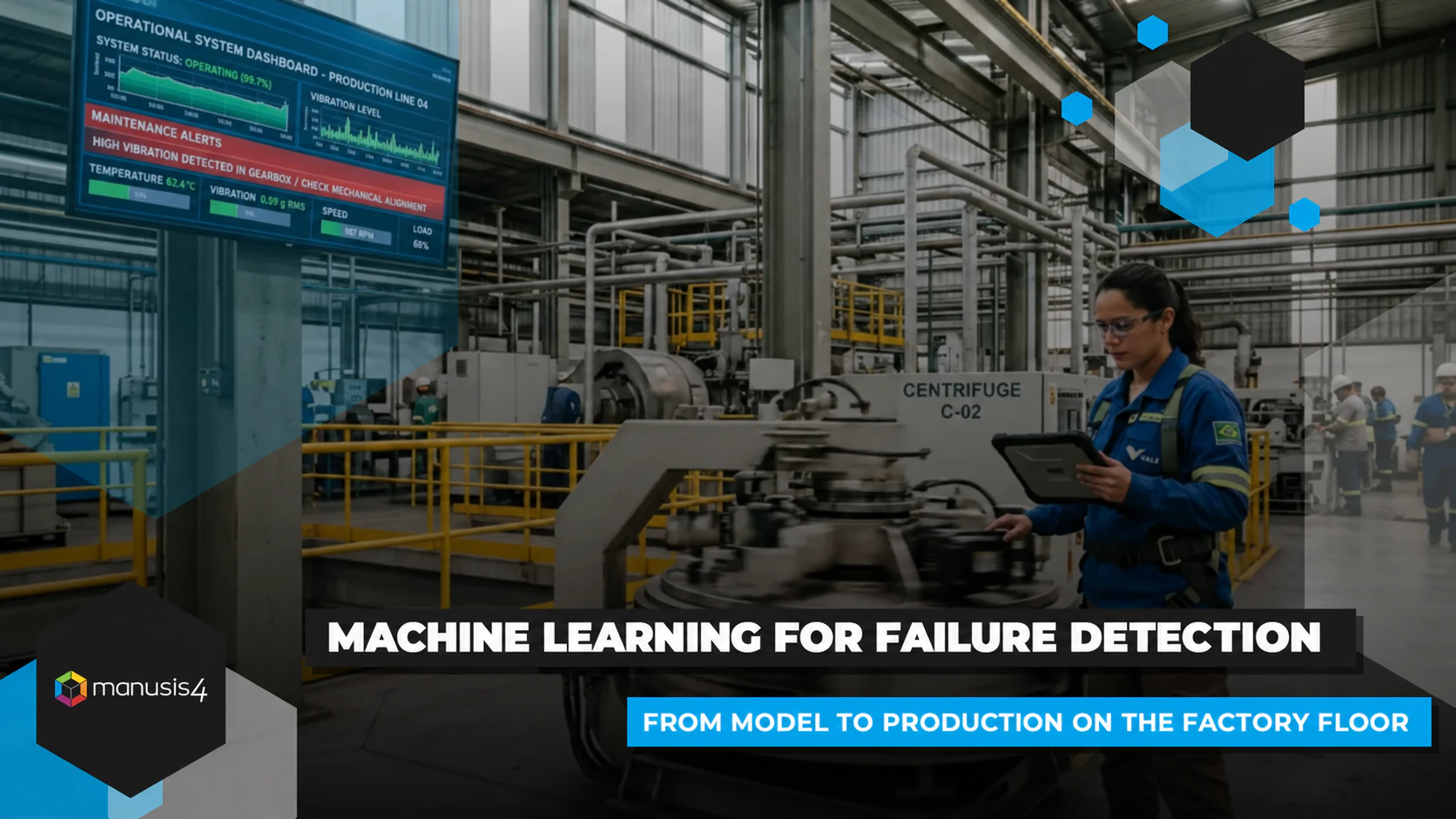
Applying machine learning to failure detection is relatively straightforward in a data scientist's notebook. The difficult part is getting that model to work every day on the factory floor, predicting real breakdowns in real assets. Between the prototype that performs well on historical data and the system that supports maintenance decisions lies a gulf—and that is where most projects die. This article is about crossing that gulf: from model to production.
Why do most models never reach production?
Most models fail because of gaps in planning, scope, and data rather than technical shortcomings. This is what MLOps best-practice guides point out: before choosing the algorithm, you need to ensure the data is ready and the business outcome clearly defined. Otherwise, the model becomes an academic exercise that never generates value.
Add a challenge specific to maintenance: historical failure data is scarce. A machine that works well rarely breaks down, so there are too few failure examples for the algorithm to learn from. Modeling “normal” is easy; teaching the machine to recognize rare events is the real problem.
From data to model: the stages supporting detection
Reliable failure detection starts with a well-designed data chain. It begins with acquisition—IoT sensors continuously capturing vibration, temperature, current, and pressure. Next come data ingestion and processing, feature engineering—turning raw signals into variables describing asset health—and only then model training.
Skipping any stage is expensive. A good model fed bad data makes mistakes confidently—and a false alert destroys the team's trust faster than any breakdown.
Putting a model into production is an operational problem
Taking machine learning into production involves less data science and more operational engineering. A model that works well today ages: the asset wears, the process changes, and raw materials vary. Without drift monitoring and periodic retraining, it silently deteriorates and starts making mistakes without warning.
That is why MLOps practices—drift detection, automated retraining, continuous integration pipelines, and explainability—are not luxuries: they keep the model alive. Explainability matters especially in maintenance: a technician will only act on an alert they understand and trust.
Where Manusis4 fits into failure detection
This is where artificial intelligence applied to maintenance stops being a promise and becomes routine. Hive, Manusis4's generative AI, learns from operational data, historical records, IoT sensors, and human interactions to anticipate problems and suggest actions. MetaCode, the platform's core, interprets data from different sources to give the alert context.
The critical point is the final step: turning prediction into action. Manusis Insights converts the model's trigger into a work order inside the system the team already uses. With more than 1,000 API endpoints to feed real data into the model and over 50 KPIs to measure the outcome, the model leaves the notebook and starts operating on the factory floor.
Ultimately, putting ML into production is not about having the most sophisticated algorithm. It is about reliable data, integration, and continuous operation. The right question was never “Which is the best model?” but “Does this alert reach the technician in time to act?”