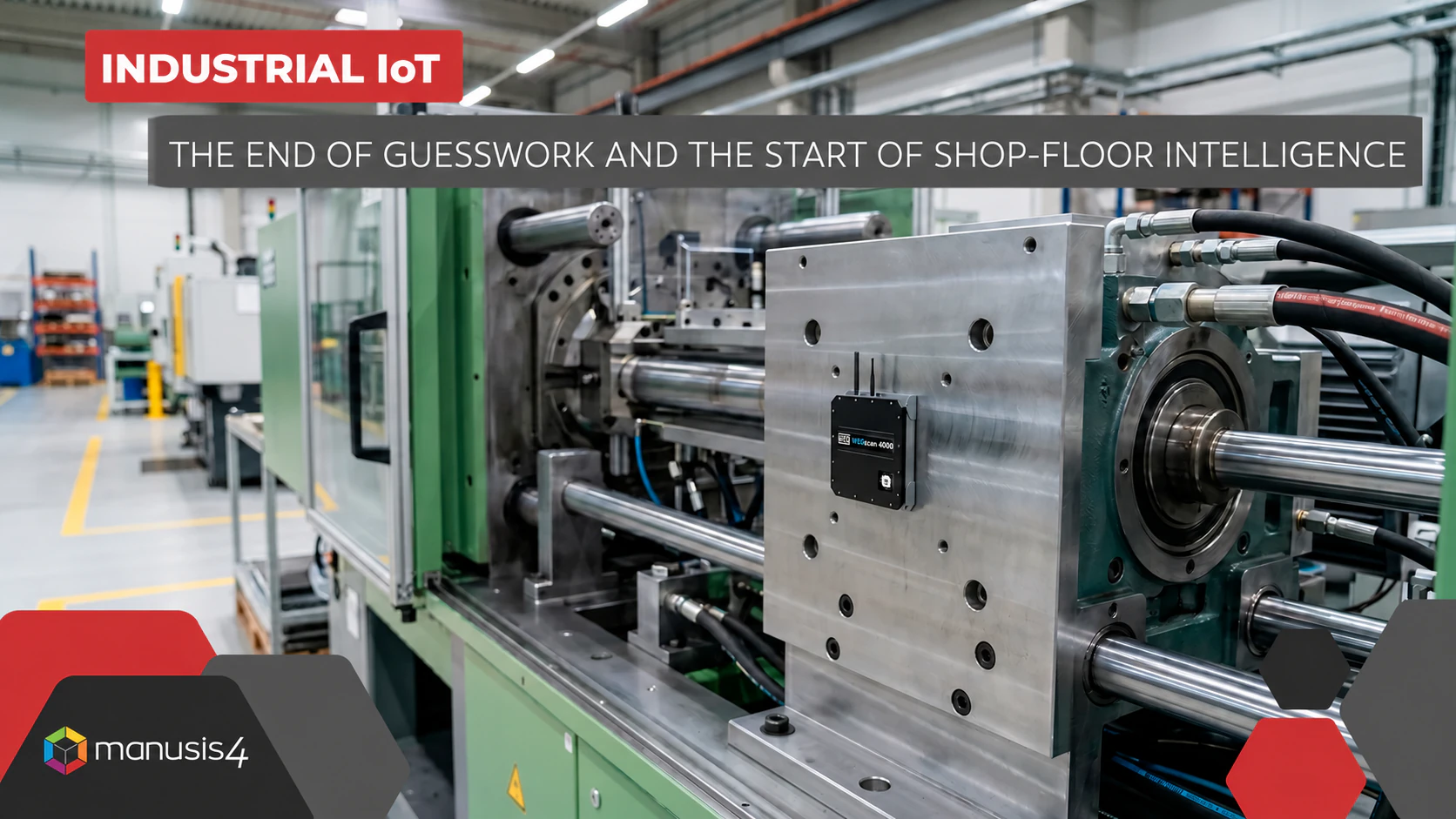
The sensor triggered. The data arrived. No one knew what to do with it. This is the most common situation in plants that implemented industrial IoT without the necessary analytics layer—and it is precisely where most projects fail before producing results.
The promise of IIoT is not about collecting terabytes of vibration, temperature, or electrical-current data. It is about turning that data into concrete actions, at the right time, for the right team. Without this link, the sensor is simply another source of noise on a dashboard no one can interpret.
Maintenance managers often ask the wrong question: “Do we have sensors?” The right one is: “What are our sensors telling us to do?”
Sensors without intelligence are just noise
IIoT is often sold as a magic solution: “Install sensors and all your problems will disappear.” Reality on the factory floor is different. Sensors without analytical intelligence create noise, confusion, and frustration—and erode the team's trust in technology before the project has even matured.
The problem is not the technology itself, but the absence of context. A sensor registering vibration outside the operating limit solves nothing unless a system can interpret that data, cross-reference it with the asset's history, and generate a clear recommendation. Technicians do not need a complex vibration spectrum; they need a straightforward notification: “Replace the bearing on motor M-04 within the next 48 hours to prevent a catastrophic shutdown.”
When analytical intelligence is applied correctly, the results are measurable. Deloitte data indicates that companies implementing predictive maintenance with IIoT can reduce maintenance costs by 10% to 25% and equipment downtime by up to 25%. This does not come from isolated sensors, but from sensors integrated into an architecture that closes the loop between data and decisions.
The architecture of an IoT solution that works
An effective industrial IIoT solution operates across four interdependent layers:
- Sensing: vibration, temperature, pressure, electrical-current, and ultrasound sensors on critical assets.
- Connectivity: industrial gateways securely transmitting data to the cloud or an on-premises server.
- Analytical intelligence: machine learning algorithms processing raw data, identifying anomalous patterns, and generating alerts with context and recommended actions.
- Action: integration with the CMMS to generate work orders automatically, track resolution, and close the operational loop.
The third layer is the most critical and the most frequently overlooked. Without it, the company has raw data. With it, it has predictive maintenance management based on statistical patterns rather than calendars or intuition.
Projects stopping at the second layer deliver dashboards full of information and teams with no clear answer about what to do next. The investment is there, but the operational result never arrives.
Why does the analytics layer determine IIoT success?
In practical terms, the analytics layer distinguishes a monitoring system from a decision system. Sensors capture signals; machine learning algorithms identify which signals indicate an imminent failure, how urgent it is, and what action is needed. Without this processing, alerts arrive without context—and technicians return to guesswork to determine the next step.
Analytical intelligence works with patterns learned over thousands of operating hours from similar equipment. This means the system does not react to failure: it anticipates it. The interval between the alert and the actual failure is the opportunity to act without unplanned downtime, end-of-shift urgency, or emergency spare-parts orders.
Two factors determine whether this model delivers consistent results:
- Data quality at the source: poorly positioned sensors or low sampling rates generate false positives that destroy the system's credibility with the operations team.
- CMMS integration: without it, the alert stops in an email and the work order is never generated—the loop breaks at its most critical point.
The hidden cost of operating in the dark
The most visible cost of reactive maintenance is unplanned downtime. But a less obvious cost rarely appears in performance reports: excess consumption of parts and labor because maintenance is performed earlier than necessary.
Without analytical intelligence, teams replace components according to the calendar rather than their actual condition. Replacing a bearing with 40% of its useful life remaining creates an avoidable cost, multiplied across hundreds of assets throughout the year. Analyses of the evolution of industrial asset monitoring indicate that most plants still operate a significant proportion of their equipment without permanent sensor coverage, leaving maintenance decisions dependent on periodic inspections or operator reports.
There is also an invisible dimension: dependence on people. In plants without IoT, knowledge about asset condition is concentrated in the most experienced technician. When that professional leaves, they take years of intuitive diagnosis that no spreadsheet recorded. Industrial IoT democratizes that knowledge and reduces the operational vulnerability already created by the shortage of skilled workers in the Brazilian market.
Real results in demanding environments
In sectors where an equipment failure has direct consequences for human lives—such as high-complexity hospitals—expectations of industrial IoT go beyond operational efficiency. Facilities implementing continuous monitoring with predictive analysis recorded an increase in the availability of critical life-support systems from 97.2% to 99.6%.
This result is possible because IoT eliminates guesswork. Maintenance management stops relying on the most experienced technician's intuition and starts operating on mathematical certainty, validated by models trained on real operating data from similar equipment.
The impact is threefold: less dependence on specialized labor, interventions taking place at precisely the right time, and elimination of both premature-maintenance waste and the real cost of catastrophic failure.
FAQ
What is needed to implement industrial IoT in a plant?
Implementation begins by mapping critical assets and installing sensors appropriate to the type of failure being monitored—vibration, temperature, or pressure. The most decisive step is choosing the analytics platform: it determines whether the data will generate concrete decisions or merely feed a dashboard without action.
Does industrial IoT work only in large plants?
No. Lower sensor and connectivity costs have made IIoT accessible to medium-sized operations. The relevant criterion is asset criticality, not plant size. A production line with a single bottleneck already justifies an investment in continuous monitoring.
How long does it take to achieve a return on an IIoT maintenance project?
Plants starting from predominantly corrective maintenance report cost reductions of 20% to 40% in the first two years. Returns accelerate when there is CMMS integration and automatic generation of work orders based on actual asset condition.
From intuition to data: the next step
Maintenance based on intuition has an expiration date. Every unplanned shutdown in a plant without continuous monitoring is a cost real data could have prevented—and it recurs until the operation closes the loop between sensor, analysis, and action.
Manusis4 operates at this intersection: an EAM platform integrating predictive IoT with the CMMS without the complexity of large-scale IT projects. If your operation still depends on spreadsheets to track asset condition, the next step is simpler than it seems.