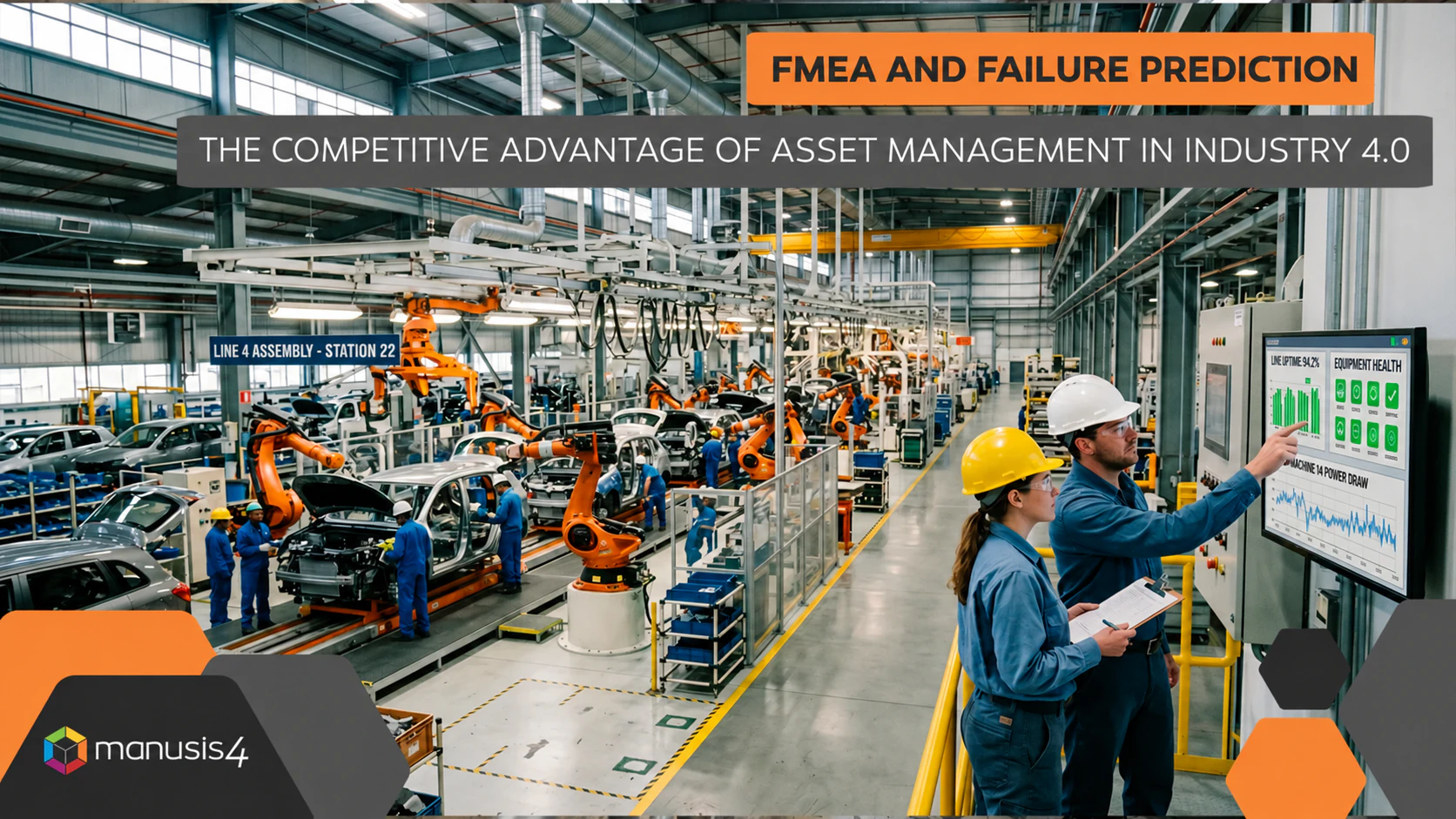
The sensor indicated unusual vibration three weeks before the shutdown. The failure-prediction data was in the system—no one checked it. The line stopped for six hours. Emergency repairs cost four times what a planned intervention would have cost. This pattern repeats in industrial plants that collect data but have yet to turn it into decisions.
Professionals with decades of asset management experience and SMRP certification have watched the market's evolution—and sometimes its shortsightedness—at close quarters. Many focus on the number of sensors installed or basic reporting features, failing to recognize that the true competitive advantage lies in software intelligence and asset management aligned with standards such as PAS55.
In this Industry 4.0 landscape, FMEA (Failure Mode and Effects Analysis) and failure prediction have evolved from reactive methodologies into proactive, intelligent tools. The objective is not simply to identify what might fail, but to predict when and why, with a precision that turns data into strategic decisions and tangible business results. The central problem is not the sensors. It is what is done with what they capture.
Beyond the sensor: intelligence that turns data into value
The market is flooded with solutions promising real-time monitoring through sensors. Raw data alone is just noise without an intelligence engine able to process it, give it context, and turn it into actionable insights. This is where intelligent FMEA stands out: it not only automates data collection, but applies machine learning algorithms to identify subtle patterns, anomalies, and correlations that human analysis or legacy systems would miss.
In practical terms, FMEA applied to predictive maintenance does more than predict isolated failure modes: it creates a cycle in which every anomaly detected feeds the prediction models, making them more accurate over time. The result is preventing catastrophic failures, optimizing maintenance plans, extending asset life, and improving indicators such as OEE and MTBF.
Asset management with industrial predictive maintenance is built around precisely this cycle. The most frequently documented operational gains include:
- Reduced response time to anomalies: planned intervention instead of emergency repair.
- MTBF optimization: continuous failure analysis increases the mean time between failures for each asset.
- Criticality-based prioritization: FMEA determines where to concentrate resources—not every asset requires the same level of attention.
- Less capital tied up in inventory: reliable prediction removes the need to oversize spare-parts stocks.
- Historical traceability: every documented failure mode informs future equipment specification and replacement decisions.
PAS55 and FMEA: the foundation for world-class asset management
Asset management is not a fad; it is a strategic discipline requiring rigor and alignment with global best practices. PAS55, and now ISO 55000, provide an established framework for organizations to maximize the value of their assets throughout their life cycles. While many operations become distracted by discussions about individual technologies, those making progress concentrate on building solutions that fit this framework—ensuring software intelligence is a fundamental pillar rather than an optional extra.
Systematic analysis of failure modes and their effects is more productive when performed continuously, either during asset design or as an ongoing operating protocol. This approach has already been validated in large-scale industrial operations in Brazil: a major automotive manufacturer refined its predictive maintenance strategy by identifying potential failures in critical components before they interrupted production. The intelligence was not in the installed sensor, but in the analytical protocol turning the signal into action.
Compliance with PAS55 and ISO 55000 is not bureaucracy: it is the foundation distinguishing operations that react from those that anticipate. Since the cost of a catastrophic failure rarely stops at the repair, the question changes.
Failure-prediction results: OEE, cost reduction, and tangible ROI
For maintenance and reliability managers, measurable results are what matter. Improved OEE is not just a number: it directly represents more efficient production, less waste, and greater delivery capacity. The real cost of unplanned downtime goes beyond parts and labor: it includes lost production, rescheduling sequences, overtime, and contractual penalties.
Lower maintenance costs are a natural consequence of proactive asset management. By predicting failures in advance, teams can avoid expensive emergency repairs, optimize spare-parts inventory, and plan interventions more effectively. ROI becomes apparent as asset life is extended, productivity increases, and operational resilience strengthens—without a proportional increase in technician headcount.
The hidden cost of failures you do not see
Most managers calculate the impact of a shutdown using machine downtime and repair cost. That calculation is incomplete. A stopped automotive line forces the entire production sequence to be rescheduled, triggers overtime, compromises delivery contracts, and erodes the predictability of monthly planning—even when the repair itself is quick.
There is also the cost of a postponed decision: every failure mode not documented in FMEA is an invisible risk until it materializes. Operations without structured failure histories repeat the same mistakes months or years apart without recognizing the pattern. A high MTTR on a particular asset rarely indicates a problem with the technician. It almost always indicates the absence of a protocol based on real data. The most surprising angle is that the greatest cost is not the failure itself, but the failures that keep recurring because the first one was not documented.
FAQ
What is FMEA and how does it apply to industrial maintenance?
FMEA (Failure Mode and Effects Analysis) is a methodology for identifying, analyzing, and prioritizing possible failure modes in an asset or process, assessing the effects and probability of each occurrence. In industrial maintenance, it turns the maintenance plan from a static document into a dynamic decision-making tool, guided by real data rather than a fixed routine.
What is the difference between predictive maintenance and FMEA?
Predictive maintenance monitors an asset's condition in real time to detect signs of deterioration before failure. FMEA organizes knowledge about possible failure modes, determining what to monitor and with what priority. The two methodologies complement each other: FMEA defines the map; predictive maintenance navigates it.
The future is intelligent, not just connected
While the market remains dazzled by connectivity and data volumes, the conviction guiding the most mature industrial operations is clear: intelligence is the true differentiator, not the number of sensors installed. Intelligent FMEA and failure prediction, powered by software aligned with best practices such as PAS55, are key to unlocking the full potential of industrial assets.
This is where Manusis4 works: integrating FMEA and predictive maintenance in a 100% web-based EAM platform built to turn factory-floor data into traceable decisions. It is not about having more sensors, but about being able to turn their data into action before a failure occurs. For leaders seeking a sustainable competitive advantage, the answer is not in the hardware, but in the intelligence structuring the entire asset management chain.
If your operation already collects data but still reacts to failures instead of anticipating them, see how plants with similar profiles are already implementing predictive maintenance with FMEA in practice.