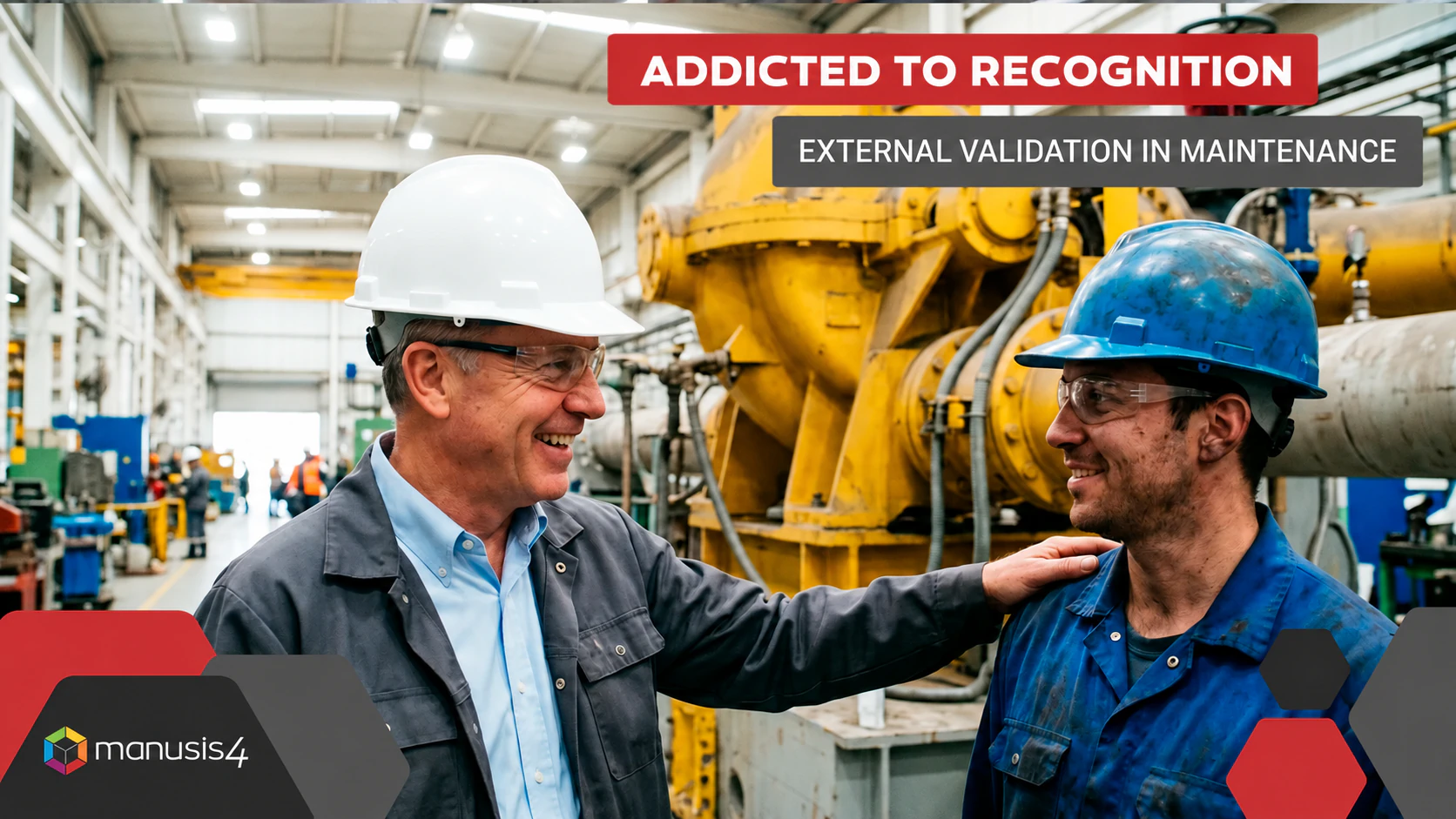
The discharge pump seized at three in the morning. Diagnosis was quick, the mechanical seal was replaced in record time, and the production line was running again before the main shift. The technician closes the work order, puts the tools away, and waits. The manager walks past, checks the area's dashboard, and carries on without a word. Dependence on external recognition starts precisely in that interval of silence in industrial maintenance.
A silent saboteur operates inside many professionals on the factory floor. It does not appear in technical training matrices, job descriptions, or the operation's organizational chart. Yet it drives critical decisions, affects behavior, and dictates the pace of everyday delivery. When applause becomes the sole fuel for work, the entire operation faces risks that spreadsheets cannot measure.
Chronic dependence on validation creates reactive teams, exhausts leaders, and conceals deep problems in operational culture. Understanding the root of that dependence is the first step toward restoring technical autonomy.
Praise that becomes addictive—and silence that destroys
Dependence on applause is a serious behavioral trap. It is the inner voice that repeatedly asks whether an intervention was performed well, whether planning noticed the effort, or when financial and professional appreciation will arrive. When that response fails to materialize, delivery quality falls sharply and pride in the work fades.
Research on talent management shows that the absence of structured feedback and ongoing recognition can increase the risk of losing professionals and declining engagement by up to 54% (2021). The professional's energy becomes entirely dependent on an outside stimulus, creating a cycle of frustration that directly affects response times in the field.
- Motivation fluctuates dangerously with the mood of the shift leadership.
- Technical focus shifts from genuinely solving the problem to securing quick approval from the boss.
- Lack of validation affects shift handovers and the team's climate.
- Proactive decisions are abandoned because they do not create immediate visibility.
The chronic absence of this validation drains the team's energy. Instead of being read as a sign that everything is operating normally, corporate silence is interpreted as professional invisibility.
Why is maintenance vulnerable to this dependence?
Factory-floor culture has historically treated machine availability as the basic rule and failure as a punishable exception. Professionals grow in an environment where consistent successes are not celebrated, because “doing what needs to be done” is the minimum expected standard, while the first mistake attracts the attention of the entire executive team.
In practical terms, maintenance teams become emotionally vulnerable because everyday success is treated as an invisible obligation, while an isolated failure causes visible downtime and immediate demands. This creates an environment in which technicians seek continuous external validation to compensate for the stress of being exposed when things go wrong.
Repeated over years, this punitive pattern creates an emotional void in teams. When success brings no relief but a mistake triggers an immediate crisis, technicians internalize the idea that their work has no intrinsic value. Occasional praise provides momentary relief; when it does not come, a sense of worthlessness dominates behavior. The team starts working simply to avoid being noticed for a mistake.
What locus of control teaches about self-confidence
Behavioral science explains this dynamic through a widely studied concept: locus of control. Individuals operating with an external locus believe their technical and personal worth depends entirely on other people's judgment. Self-esteem becomes hostage to others' opinions, and any criticism, even constructive criticism, is received as a destructive personal attack.
Professionals who develop an internal locus take control of their own motivation in everyday maintenance. They anchor their value in what they recognize in themselves and the concrete results they deliver for plant availability. Their work reaches a standard of excellence because that is their natural technical rigor, rather than because an audience is waiting to applaud.
In this state of technical maturity, difficult decisions are made with clinical clarity. The professional assesses a potential failure, analyzes the vibration or leak, and decides to intervene based on technical facts, remaining firm even under pressure from the production manager demanding that the machine keep running.
The hidden cost of dependence on validation
The less apparent impact of this emotional immaturity erodes the foundations of industrial reliability. The greatest hidden cost of dependence on recognition is not temporary demotivation, but the hijacking of the plant's operational intelligence. When the focus is on pleasing management, the team stops reporting early anomalies that could create friction with operations and concentrates only on fighting already visible fires.
Maintenance decisions stop being guided by technical indicators—such as a bearing's tolerance limit—and start being based on what the coordinator wants to hear. Innovations and workflow improvements die before they are born, because no one risks proposing a project without an immediate guarantee of attention and celebration.
Experienced professionals, tired of this silent competition for attention disguised as dedication, eventually seek other employers. The knowledge lost when a specialist leaves because they felt invisible has an incalculable impact on asset life-cycle costs.
Technology as a mirror of internal recognition
At this point of saturation, digitizing planning can drive profound behavioral change. Technology gives professionals the undeniable ability to see, in real time and through concrete data, the everyday impact of their tools. The system stops being merely a repository of forms and starts making the shift's effort tangible.
When completed work orders, recovered machine hours, and preventive-route completion rates are documented, dependence on a pat on the back loses its strength. Manusis4's maintenance module consolidates this reality, turning fragmented records into clear visibility of individual and collective performance. Technicians can track their own success rates and the effect of their inspections on the health of the plant's equipment.
The platform reflects the team's competence through concrete data, unaffected by a manager's forgetfulness or preferences. The team's self-esteem becomes grounded in hours of availability secured and failures mitigated at the source. Internal recognition finally gains a solid, auditable foundation.
A daily reset at the end of the shift
Disabling a chronic need for approval takes daily action, not just motivational speeches at the end of the year. Emotional maturity in industry grows when technicians develop their own validation rituals before clocking out. Awareness of their own impact must be practiced until it becomes an automatic reflex.
- Mentally or in writing, record the accurate diagnoses completed during the shift.
- Avoid labeling daily lubrication tasks as “minor” or “insignificant.”
- Observe reductions in emergency calls in the area under your responsibility.
- Validate your own technical rigor by following safety procedures to the letter.
This daily closure teaches the mind to recognize the value of technical work before any supervisor does. After a few months of practice, this new behavioral anchor shields the team against frustration, reducing stress and raising service quality.
Frequently asked questions
How does dependence on praise compromise operational safety?
Professionals focused solely on quick approval tend to carry out temporary fixes to demonstrate immediate results. This encourages operational shortcuts and neglects the root-cause analyses essential to preventing accidents and catastrophic failures over the long term.
What replaces constant verbal feedback in team management?
Complete transparency of data and indicators. When technicians can see reliability improving in the machines under their care, concrete data replaces the need for empty praise, anchoring their perception of competence in the reality of the assets.
The true measure of success
Dependence on continuous approval is often disguised as career ambition or a pursuit of excellence, but in practice it drains efficiency. Professionals who need a manager to affirm their value every day are the first to fall apart when production-volume pressure rises and time for formal feedback disappears. True reliability comes from teams operating with clear data, structured autonomy, and confidence in their own technical rigor. If your team still relies on spreadsheets and manual reports to prove that maintenance creates value, the next step toward changing that reality is simpler than it seems.