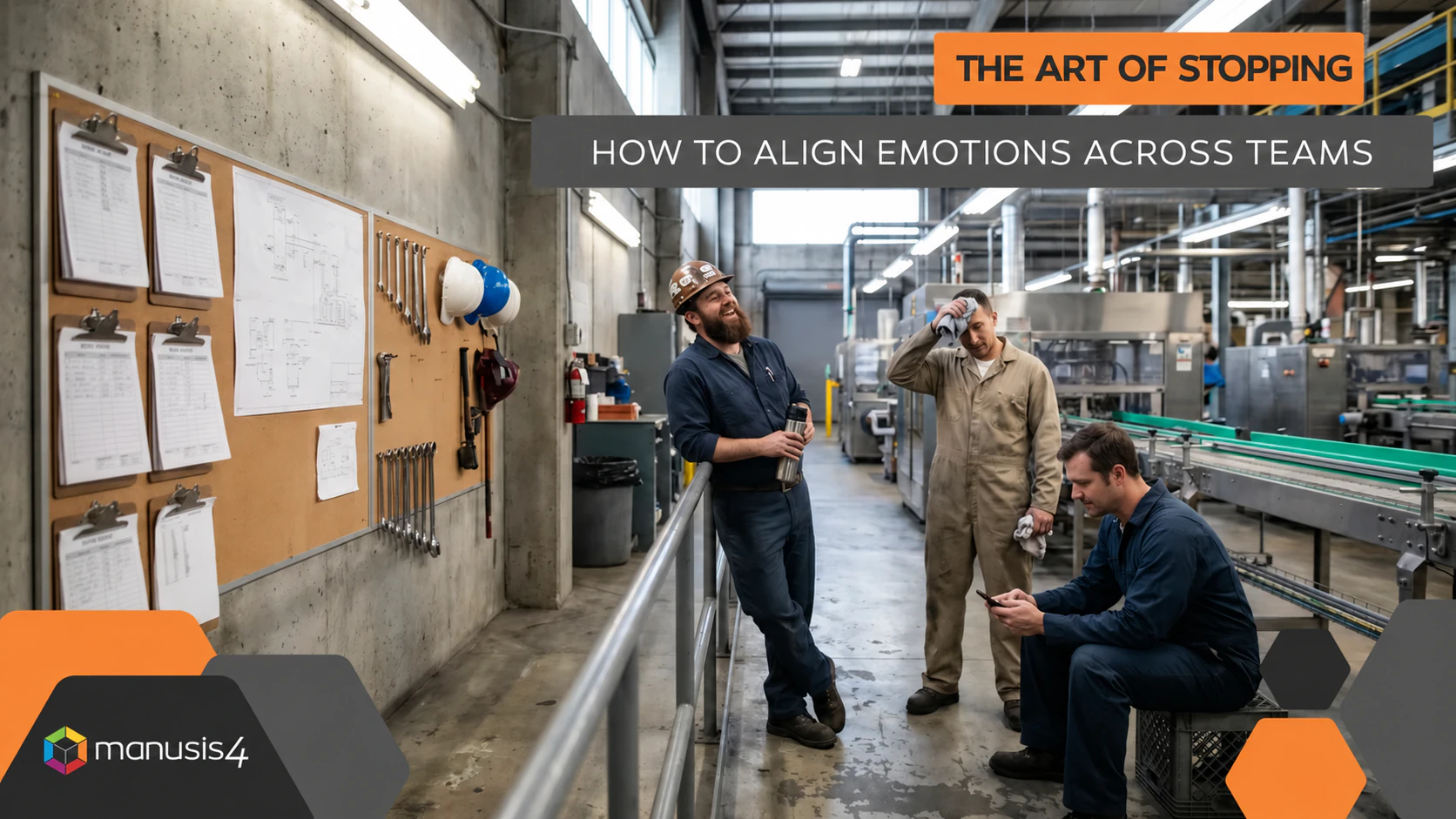
The technician arrived. The tools were checked. The work order was open. The required part was not in the storeroom. The machine was stopped. Pressure rose. A decision had to be made quickly. And it is at this moment, under tension with no breathing space, that a mistake happens—not because of a lack of competence, but because of excessive strain without recovery.
A silent belief haunts factory corridors: “Stopping wastes time.” It is not written on any noticeboard, but lives in the culture of people who grew up in the field. It undermines the team's performance every day. Those working on autopilot believe speed is synonymous with productivity. A lack of breaks in industrial maintenance is a direct route to errors, rework, and exhaustion.
Why does maintenance without breaks fail more often?
Maintenance professionals look after machines all day. They know equipment operating continuously, without lubrication, adjustment, or inspection, fails. Wears out. Breaks down. But what about the mind of the person operating it? The mind of the person leading?
The reality is harsh: the steel asset receives more preventive care than the human asset operating it. When the human system breaks down, the entire department becomes disorganized. Neuroscience applied to performance is clear: overloaded mental states produce worse decisions. Always. When the brain operates in saturation mode, perception narrows, creativity diminishes, tolerance for frustration plummets, communication becomes reactive, and focus fragments. Worse still, the person does not even realize they are making decisions with only a fraction of their actual capacity.
Does a team that never pauses deliver results? Yes, in the very short term. In the medium term, the costs emerge: more rework, growing interpersonal conflict, multiplying diagnostic errors, rising absenteeism, and faster turnover. And the most treacherous symptom: productivity falls without anyone being able to identify why. The indicators become strange. So does the climate. All because the human system operated without preventive maintenance.
If the human cost is invisible in reports, where does it materialize in the operation's financial results?
What is the hidden cost of operating without breaks?
The most dangerous impact of a “no breaks” culture is not what appears on the timesheet, but what is never recorded. Decisions made under cognitive fatigue produce incorrect diagnoses, leading to unnecessary component replacements, consumption of parts that would not solve the problem, and labor hours spent in the wrong direction.
The hidden cost is not the break: it is the rework caused by its absence.
- Accurate diagnosis at the first intervention eliminates return visits to the same asset.
- Conscious prioritization avoids sending the team to false emergencies.
- Clear communication reduces conflict and rework caused by misunderstandings.
- Mental recovery sustains attention during high-risk tasks.
- A routine with predictable breathing space reduces absenteeism and turnover.
A technician who pauses for 90 seconds between critical tasks regains the clarity to read a symptom correctly. A manager who takes a breath before prioritizing avoids reallocating the team to an emergency that was not an emergency. In practical terms, a strategic break reduces diagnostic errors and rework by restoring analytical capacity before the next operational decision, protecting time, parts, and labor from avoidable waste.
If breaks protect results, how can they become feasible in an operation that cannot stop?
How operational clarity makes it possible to pause without losing control
Breaks are only sustainable when the operation has visibility. Visibility comes from an organized maintenance schedule, clear and current priorities, logically distributed tasks, a history preventing repeated work, and alerts distinguishing critical issues from noise. When these elements are structured in a maintenance management platform, managers trust that they can stop for five minutes. Technicians trust that they can breathe between work orders. Leaders know the system is looking after what is critical.
Properly applied technology gives the team back the right to pause—not as a luxury, but as part of the process. Plants such as those of a major automotive manufacturer already operate with this model: the system's clarity makes breaks routine rather than exceptional. The result is not less production, but sustained production with fewer errors, less conflict, and less strain.
Taking a break is not the opposite of productivity. It sustains productivity throughout the shift, the week, and the month. Athletes take breaks. Surgeons take breaks. Pilots take breaks. Maintenance professionals, who constantly make decisions involving risk, also need breaks. The difference between breaking down and keeping going lies in the ability to integrate breathing space into the routine, as a performance tool rather than an interruption.
A practical routine: the 3 conscious breathing breaks
Introducing breaks does not require radical change. It starts with a simple ritual that fits any shift:
- Start of the shift: before opening the first work order, take 30 seconds for conscious breathing.
- Middle of the shift: after a demanding task, take another 30 seconds to regain clarity.
- End of the shift: before handing over the workplace, take 30 seconds to finish with presence.
For each cycle: breathe in for 4 counts, hold for 4, and breathe out for 6. Repeat 3 times. In a combined 90 seconds, the team gains focus, presence, and decision-making capacity. Pausing does not mean stopping production. It means producing intelligently.
FAQ
Do breaks reduce team productivity? No. Strategic breaks restore the cognitive capacity needed for accurate decisions, reducing rework and diagnostic errors. What reduces productivity is continuous operation without recovery, leading to avoidable failures and accumulated strain.
How can leadership be persuaded to adopt breaks? Present the cost of rework and diagnostic errors as a direct consequence of cognitive fatigue. A break is an investment in precision, not wasted time. Data showing reduced rework after the introduction of breathing routines supports the argument.
Do breaks work in 24/7 operations? Yes. Taking a break does not mean stopping the plant; it means structuring micro-recovery periods between tasks for each technician and shift. With operational clarity and defined priorities, the team can breathe without compromising critical activities.
Conclusion
A culture of rushing has become a source of pride in maintenance. Maturity in the sector means understanding that those who pause endure, while those who do not fall apart. A break is not weakness. Not a luxury. Not unproductiveness. It is strategy. And it starts with something simple: allowing the team to breathe—and creating the operational conditions that make it possible.
If your operation still relies on spreadsheets and memory to manage priorities, the next step is simpler than it seems. Manusis4 developed Hive, an AI agent that organizes priorities and removes the noise of “everything is urgent” from operations. The system organizes schedules, history, and alerts so that taking a break stops being a risk and becomes routine. Technology with a factory-floor soul, made for people who wear work boots and need real data rather than promises.